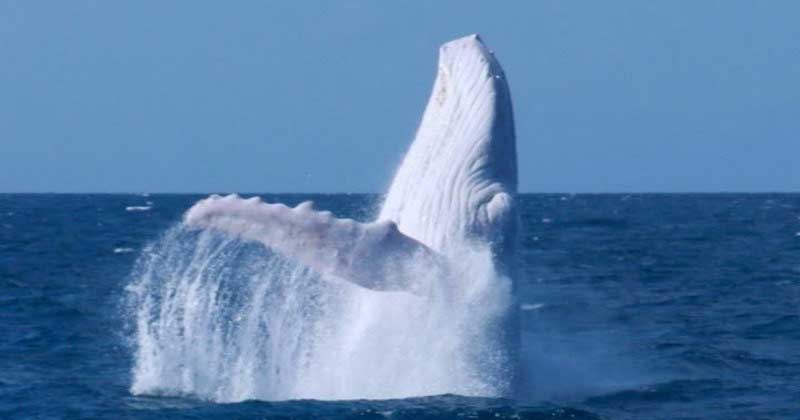
Did you know that Migaloo is the only documented albino humpback whale in the world?
Migaloo is perhaps the most famous humpback whale in the world, and a favorite here at National Wildlife Council.
His distinctive absence of pigmentation due to albinism allows people to easily identify him and report sightings.
He was first spotted in 1991 off Byron Bay, Queensland by a group of volunteers conducting a whale count.
The first photograph of Migaloo was taken through a telescope from a distance of over 5km away.
It was blurry and unclear if he was all white.
In 1993 Pacific Whale Foundation (PWF) researchers encountered this amazing white whale in Hervey Bay, Queensland.
During their first encountered they were able confirm the whale was all white, and in 1998 PWF recorded the whale singing, a trait distinct to male humpback whales.
After sharing our remarkable discovery with the public, there was an outcry to ‘name the whale’. Dr. Paul Forestell (then PWF Research Director now Board Member) and PWF Founder and Executive Director Greg Kaufman decided the naming of the whale should be done by the elders of the local aboriginal collective in Hervey Bay.
After conferring with Dr. Forestell and examining images of the white whale, they asked to have a few days to consider a name.
Ultimately they named the white whale “Migaloo” or “white fella”.
The elders further explained their connection to all white or albino animals and that they appear on earth to be respected and revered, that their unique color demonstrates the need to respect all forms of life even if they appear different than ‘normal’.
They should be honored with reverence and respect not discrimination and shame.
Since this initial encounter Migaloo has been seen dozens of times.
PWF researchers estimated he was 8 – 10 years at time of initial sighting making him approximately 32-36 years old in 2015.
He has been observed in New Zealand waters but primarily off east Australia migrating as far north as Cooktown and south past Sydney.

Migaloo is a member of the east Australian population of humpback whales.
Migaloo’s population of humpback whales feed in Antarctica from November to April and migrates along the east coast of Australia to breed near the Great Barrier Reef from May to October.
Scientists were initially skeptical to state Migaloo has albinism because his eyes are brown, rather than the typical red or pink.
In the past he has been called the more conservative terms “all-white”, or “hypo-pigmented”.
However, a 2011 study of his DNA by researchers at the Australian Marine Mammal Centre found a genetic variation leading to albinism.
Genetic testing confirmed another fact about Migaloo: he is a male.
Scientists already knew this to be the case because of his song.
While both male and female humpback whales can produce sounds, only the males sing songs.
In 1998 researchers first recorded Migaloo singing, thus indicating he is a male.
This was confirmed by genetic testing in 2004.
Are there other predominately white humpback whales in the world’s oceans?
Yes, PWF researchers have observed whales that are over 90% white off east Australia, and in 2011 observed a newborn nearly all white male calf in the Whitsundays.
This whale was named Chalkie and some have called him Migaloo Junior, however is not known to be the offspring of Migaloo – they may or may not be related.
Chalkie does have one small black dot on the dorsal surface of his left fluke making him not quite all white meaning he does not have albinism.
In recent years, a video of what appears to be an all white humpback whale feeding in waters off Norway was released on the internet which depicts a whale that looks like Migaloo, until the whale lifts its tail to dive and its fluke pattern is 75% black!
There have also been sightings of white orcas, a white right whale and a bottlenose dolphin with albinism throughout the years.